
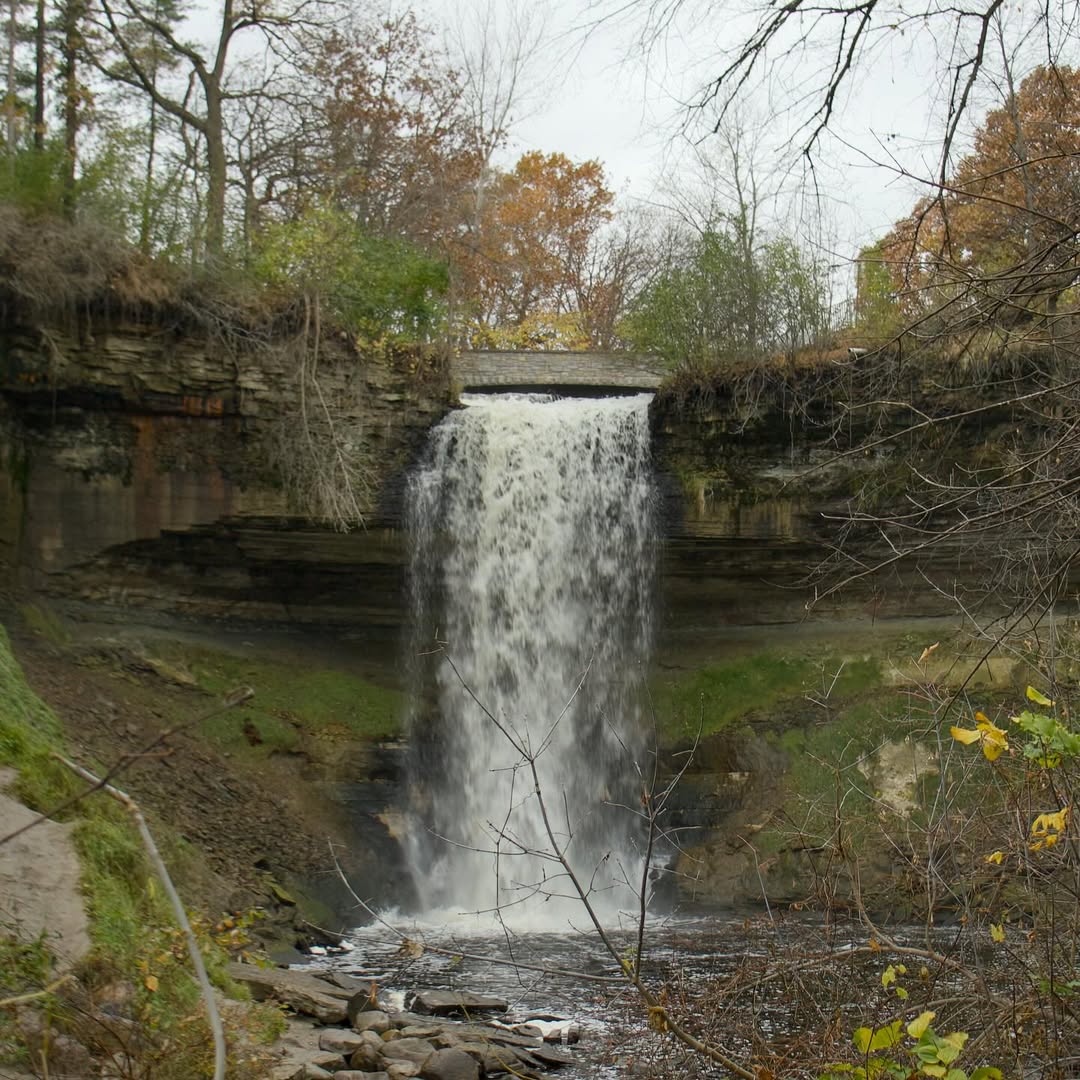
Minnehaha Falls is not what you expect to find inside a city. Minneapolis, technically — Minnehaha Park is right in the urban grid, surrounded by neighborhoods, accessible by light rail. And then there's this 53-foot waterfall dropping into a limestone gorge, with a creek trail below it that winds through overhanging bluffs and exposed bedrock, and it's just there, in the middle of everything.
The falls themselves are beautiful in any season but genuinely spectacular in winter. When it's cold enough, the falls freeze into a massive ice formation — a curtain of ice and icicles hanging from the limestone face, with the creek icing over below it. People hike down into the gorge to stand behind the frozen falls and look out through the ice. In January the whole thing has an otherworldly quality.
The park is named after the Dakota word for the creek — "minne" meaning water, "haha" meaning laughing or curling water. The waterfall sits near the confluence of Minnehaha Creek and the Mississippi River, and the gorge trail connects the two. The Mississippi is a short walk downstream, and standing at that confluence — where a small urban waterfall meets one of the great rivers of the continent — has a certain geographic satisfaction to it.
Henry Wadsworth Longfellow wrote about these falls in "The Song of Hiawatha" despite never visiting them. He worked from a daguerreotype and descriptions. The statue of Hiawatha and Minnehaha near the falls acknowledges this in a slightly ironic way.
If you're passing through Minneapolis, the park is worth the stop. The falls, the gorge trail, the creek — it's a surprisingly good hour in the middle of a city that doesn't immediately read as a nature destination. January was cold but the ice formations made it worth it.