
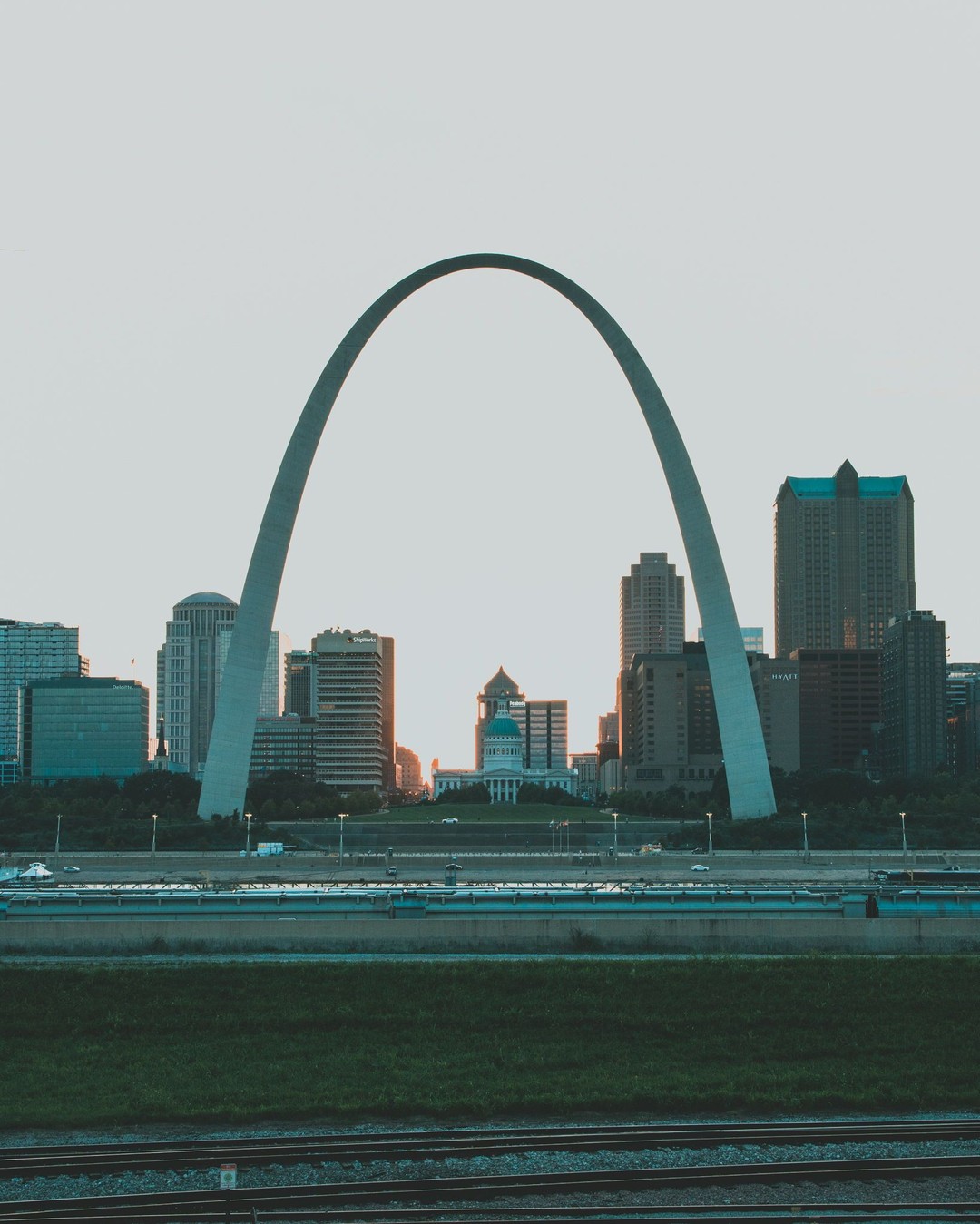
There are times of day when the Gateway Arch is better than usual, and dusk is one of them. The stainless steel panels shift from bright silver to something warmer as the sun drops, and the reflection off the Mississippi to the east adds a second version of the same glow. I've photographed it dozens of times from different angles and still find myself stopping to look.
The Arch was designed by Eero Saarinen, who won the national competition in 1947 with a catenary curve design that seemed almost too elegant to be real. Construction ran from 1963 to 1965, and the engineering of those 630 feet required tolerances measured in fractions of inches — the two legs had to meet at the top within a fraction of an inch after being built from opposite ends. They did.
From the riverfront immediately below, the scale becomes difficult to process. You're looking up at something that curves away from you into the sky at an angle that doesn't quite register as a building or a structure so much as a shape the city decided to have. The Museum at the Gateway Arch underground is serious and thoughtful, covering the full complicated history of westward expansion with appropriate weight.
The tram to the top is worth doing at least once — the pod ride itself is unusual, and the view from 630 feet is everything the brochures promise. But the version of the Arch I keep returning to is from the riverbank at the end of an afternoon, watching the light change on the steel.