
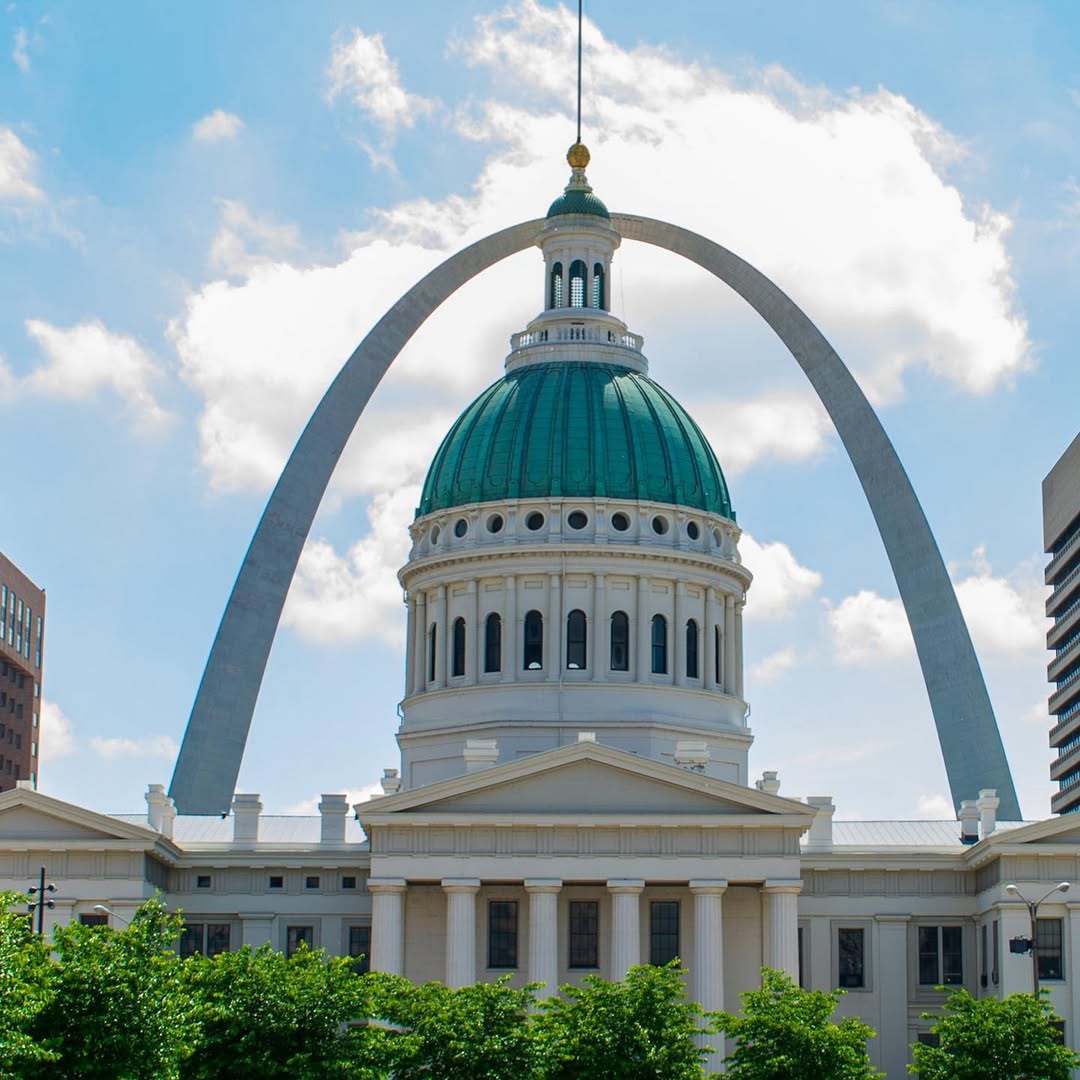
I've lived in or around St. Louis long enough that the Arch became background — something I glanced at from the highway, present in the skyline the way a familiar face becomes invisible. It took having a reason to actually go there, to stand under it and look up, to understand what all the fuss is about.
The fuss is justified. The Gateway Arch at 630 feet is still one of the most successful feats of twentieth-century design. Eero Saarinen won the commission in 1947 and spent years refining the catenary curve before construction started in 1963. What he built is something that looks almost too simple to be remarkable and yet cannot be ignored from any angle. The stainless steel panels catch light differently at every hour — flat and matte at noon, ablaze at sunset.
The tram ride to the top is its own kind of experience. You squeeze into a five-person pod that pivots as it climbs and arrives at a narrow observation deck with tiny windows tilted toward the ground. The view on a clear day stretches 30 miles in every direction. The river bends below you. Illinois is just across the water looking flat and wide and patient.
The museum at the base — free to enter — does a serious job with the history: the Louisiana Purchase, the Dred Scott case, Lewis and Clark, the settlers who moved west through this city. It doesn't flinch from the difficult parts. The Arch commemorates westward expansion but the museum makes sure you know what that expansion cost. Worth several hours if you let it be.