
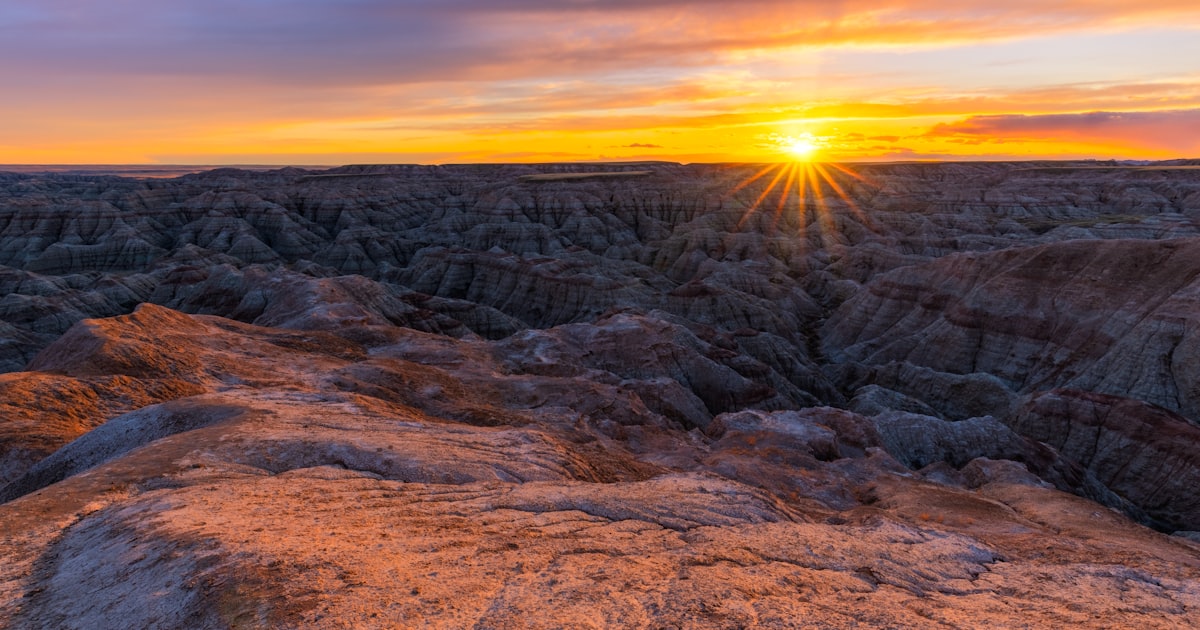
The Badlands come at you fast. You're driving through the flat, unbroken grasslands of southwestern South Dakota — which go on for a very long time — and then suddenly the earth drops away and you're looking at something that doesn't look like it belongs on this continent. Sharply eroded spires of clay and siltstone rise from the prairie floor in striped layers of ash-grey, tan, and rust, arranged in formations that look like a city designed by an alien architect. I went in November, when the grass had gone dormant and brown and the formations took on a particularly desolate quality that felt exactly right.
Badlands National Park was carved by millions of years of deposition and erosion — the formations you see are layers of sediment laid down in ancient seas and deposited by rivers, then exposed over time as the White River and its tributaries cut into the terrain. The rock erodes quickly: roughly an inch per year in places, fast enough that the landscape is measurably different from decade to decade. Fossils emerge from the eroding walls regularly; the park has one of the world's richest assemblages of Oligocene mammal fossils, and the paleontology program has been active here for more than a century.
The 31-mile Badlands Loop Road is the main access corridor, threading between the formations and offering pullout after pullout of dramatic scenery. The Notch Trail, which climbs a ladder and traverses a ledge before opening onto a canyon overlook, is the best hike I found. At dawn and dusk the formations glow in colors that shift minute to minute as the sun angle changes — it's a photographer's park in the most obvious sense.
The mixed-grass prairie surrounding the formations is the other half of the park's story: bison herds graze in the grasslands, pronghorn are almost always visible from the road, and prairie dog towns scatter across the flat sections in a way that's charming to watch. The night sky, with virtually no light pollution, is one of the most striking I've seen anywhere in the lower 48.