
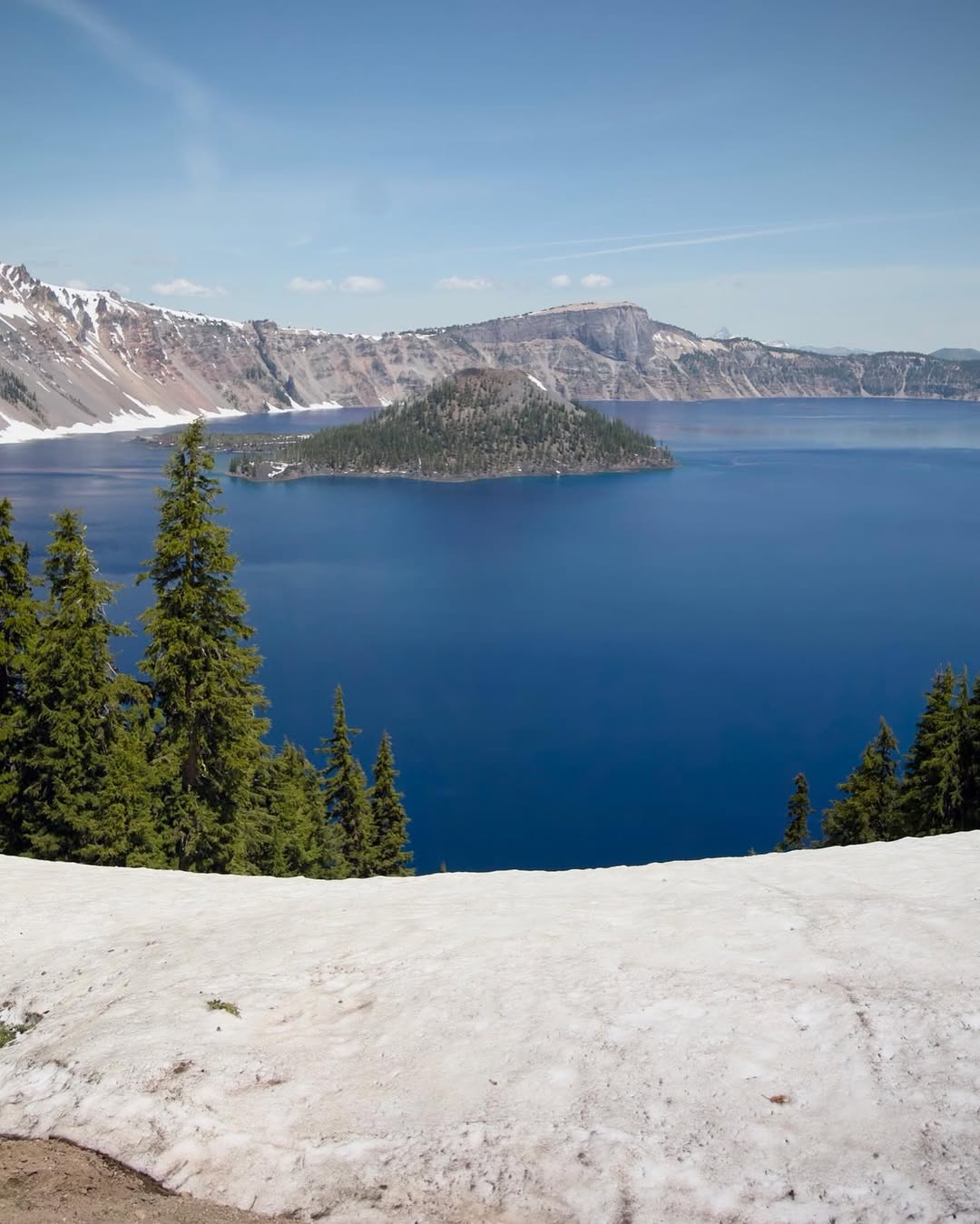
Nothing I'd read or seen prepared me for the color. I came over the rim for the first time and just stopped moving. Crater Lake is a blue that doesn't look real — not turquoise like a tropical beach, not gray-blue like the ocean, but a deep, saturated cobalt that seems to glow from somewhere inside the water itself. It's the kind of color you'd assume was a filter. It isn't. It's just what happens when a lake is 1,949 feet deep, has no rivers flowing in or out, and is fed entirely by rain and snowmelt so pure that almost nothing clouds it.
The lake sits inside the collapsed caldera of Mount Mazama, a volcano in the Oregon Cascades that erupted catastrophically around 7,700 years ago. The eruption was one of the largest in North America in the past 12,000 years — it ejected enough material to bury a city and left behind a crater miles across. Over the following centuries it slowly filled with water. The Klamath people witnessed the eruption and carried oral traditions about it for generations before European settlers arrived. What they called Llao and Skell's battle — two spirit beings — we now call geology.
The 33-mile Rim Drive that circles the lake is one of the best drives in any national park, with pullouts every few miles that reframe the view completely. Wizard Island, the cinder cone that rises from the lake's surface, shifts position relative to the rim as you move around it, and the caldera walls change color with the light. There's no bad angle. Summer is the only reliable season to visit — the park sits at elevation and can be snowed in through late spring, with the rim road typically clear from July through October.
What I keep coming back to is the silence. The lake itself muffles everything. You stand at the rim with the wind in your ears and the blue stretching out below you, and there's a particular quality to the quiet that you don't get at most places this famous. It earns the trip from anywhere.