
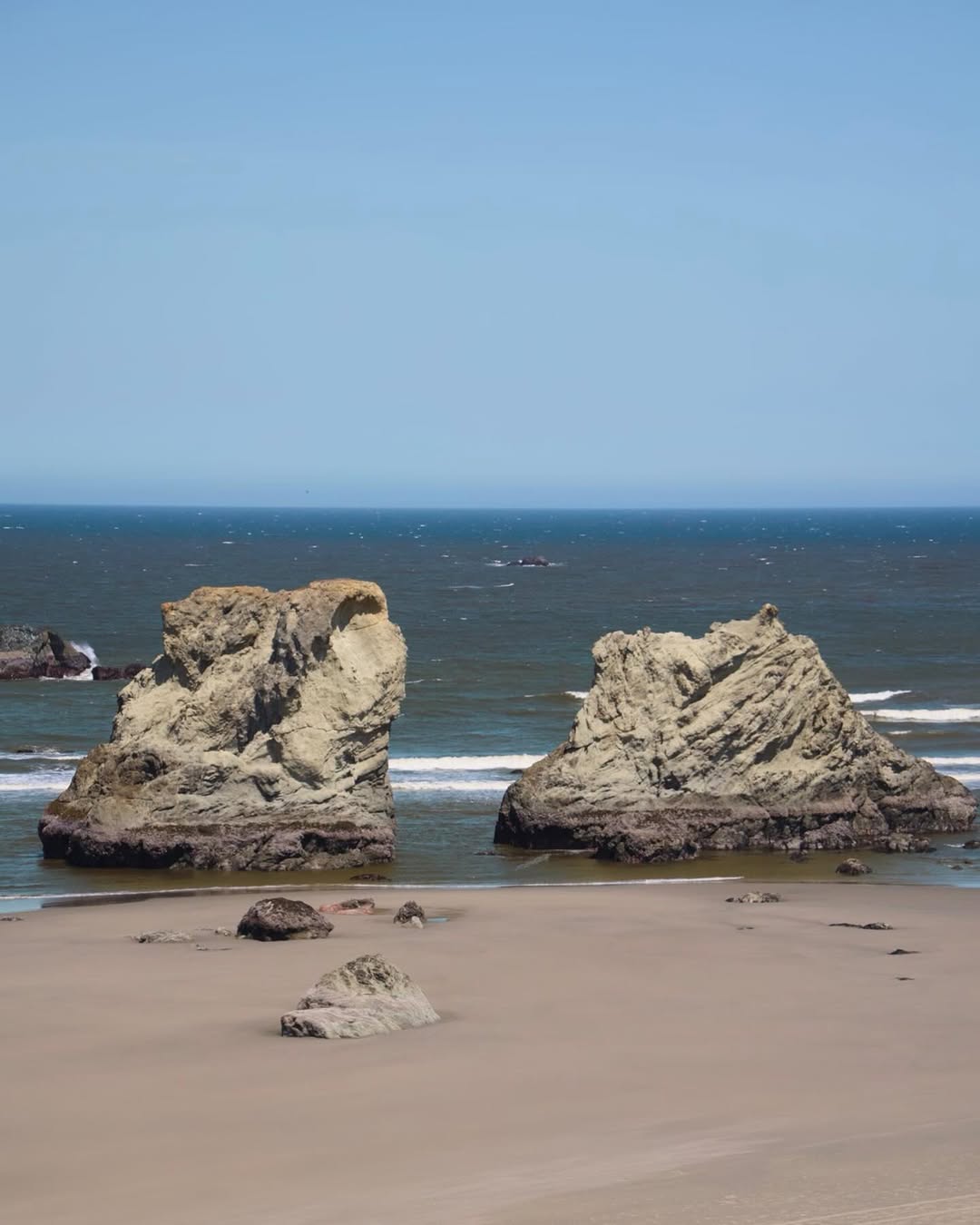
Face Rock sits offshore from Bandon on the southern Oregon Coast, a sea stack that the Coquille people called by the face of Ewauna — a chief's daughter turned to stone by a water spirit who caught her when she swam too far from shore. The face is there in the rock if you look: a profile facing skyward, chin tilted up toward the horizon, expression stoic. The Cat and Kitten Rocks nearby complete the story.
The Coquille origin narrative gives the viewpoint a character that most scenic overlooks don't have. Standing on the headland at Gravel Point, a mile south of Old Town Bandon, you're at a place where the landscape has been storied for a long time. The sea stacks are protected as part of the Oregon Islands National Wildlife Refuge, which means the bird activity on and around them is substantial — nesting habitat for cormorants, guillemots, and pigeon guillemots.
A steep stairway trail from the parking area descends to the beach below the headland. The beach stretches in both directions — south toward more sea stacks, north toward Bandon's Old Town — and the walk at low tide between the formations is worth the descent. The intertidal areas around the base of the sea stacks are rich with life when the tide is out.
Bandon itself is worth more time than most people give it: the cranberry bogs east of town, the fishing harbor, the old-growth myrtlewood trees. Face Rock is the anchor of a longer coastal experience.