
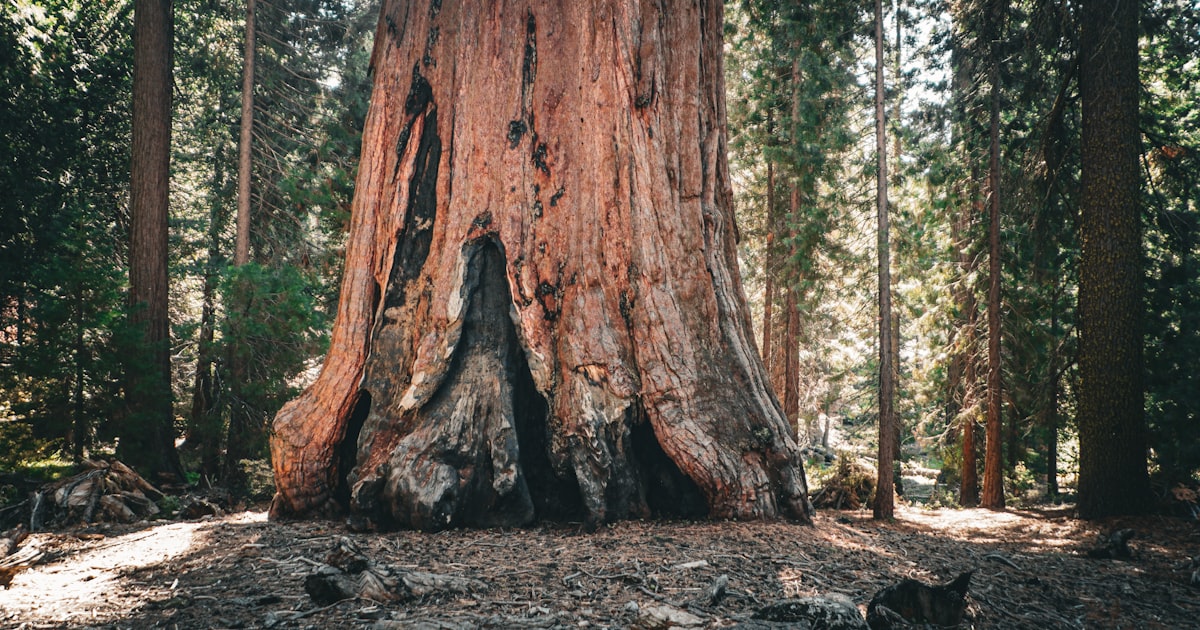
There's a moment that happens when you first walk into a sequoia grove — a moment where your brain tries to process what your eyes are seeing and just sort of stalls out. You know intellectually that these are big trees. You've seen the photographs. And then you're standing next to one and looking up at a trunk that's 30 feet across and rises to a canopy 200 feet overhead, and your brain quietly gives up trying to contextualize it. They're not like other big trees. They belong to a different category of living thing entirely.
Sequoia National Park protects the largest trees on Earth by volume — giant sequoias that can live more than 3,000 years, whose reddish-brown bark is thick enough to survive most forest fires, and whose upper canopies can contain entire ecosystems. The park's star attraction is General Sherman Tree, located in the Giant Forest, which is recognized as the largest single living organism on Earth by volume — an almost 275-foot tall, nearly 3,000-year-old sequoia with a base circumference of over 100 feet. You can walk right up to it; there's a short paved trail that winds down to the tree through the grove.
But the Giant Forest itself is the real experience — a landscape of enormous sequoias in a mixed conifer forest where the filtered light and the scale of the trees create an atmosphere unlike anywhere else. The Congress Trail is a well-maintained 2-mile loop through the heart of the grove, passing several named sequoias and an extraordinary number of unnamed giants that would be the biggest living thing for miles in any other forest. It doesn't get old.
Up at Moro Rock, a granite dome you can access via stairs carved into the rock, the views extend across the Kaweah River drainage and into the high Sierra on clear days. Crescent Meadow, which John Muir called the "gem of the Sierra," sits nearby and is exactly what the name implies — serene, quiet, ringed by sequoias and white firs. Sequoia is usually visited alongside Kings Canyon, and the combination makes for a full multi-day trip through some of the most extraordinary landscape California has.