
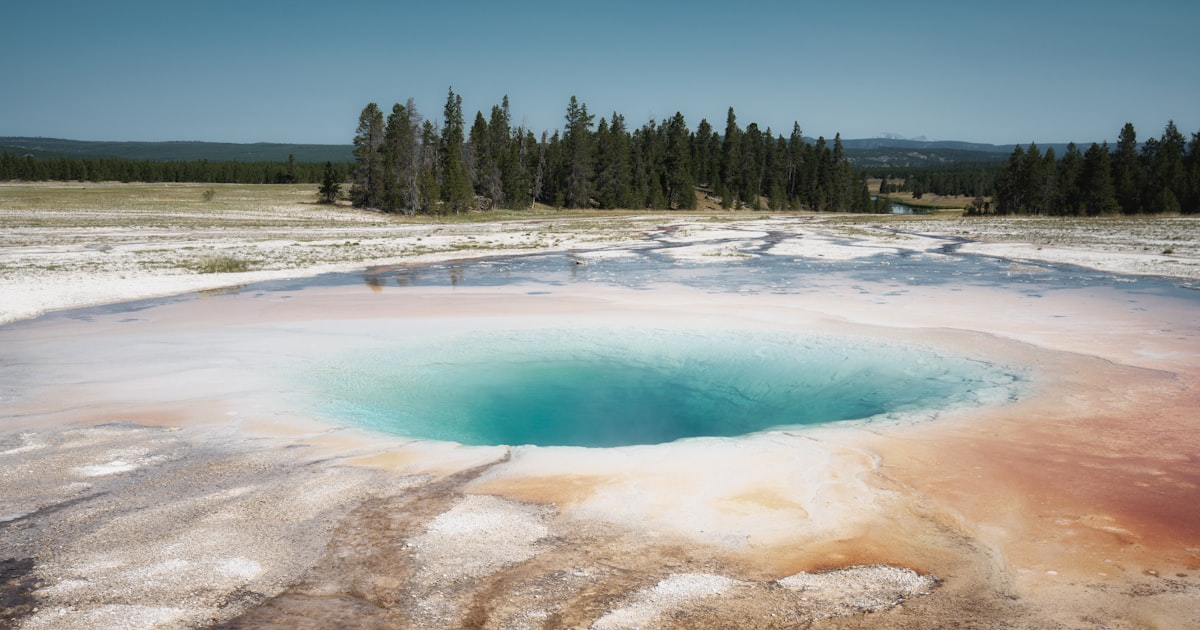
I went to Yellowstone in October because someone told me it was the best month, and they were right. The summer crush had cleared out, the aspen groves around the park perimeter had turned gold, and the elk rut was in full swing — which means that at dawn and dusk, the valleys around Mammoth Hot Springs and the Madison River filled with the strange, haunting sound of bull elk bugling. It's one of those sounds that defies description; somewhere between a screech and a roar, echoing across a landscape that was already behaving in ways that shouldn't be possible.
Yellowstone is the oldest national park in the world, established in 1872, and it sits atop one of the largest active supervolcanoes on Earth. That geological reality is what drives everything: the 10,000-plus hydrothermal features — more than anywhere else on the planet — are all expressions of the same vast heat source sitting a few miles below the surface. Old Faithful is the most famous geyser and erupts on roughly 90-minute intervals to a height of 130 to 180 feet; watching it in October with steam billowing against cold blue sky and a crowd only a tenth the size of summer is a fundamentally different experience than the photos suggest.
The Grand Prismatic Spring, in the Midway Geyser Basin, is arguably the most visually extraordinary single feature in any national park. An aerial photo doesn't prepare you for standing at its edge: a deep pool of nearly boiling water, 370 feet across, so blue at its center that it looks like it's lit from within, and surrounded by concentric rings of orange, yellow, and brown created by thermophilic bacteria. The colors change with the seasons and with the angle of sunlight. The overlook trail above it gives you the perspective the photographs use.
Wildlife is the other reason to visit. The Lamar Valley in the northeast is the park's wildlife corridor — bison herds move through in enormous numbers, wolves have denning territory nearby, and grizzly bears are spotted regularly in autumn as they range for food before hibernation. In October, with the grasses golden and the cottonwoods lit up, it looks like a landscape out of time.