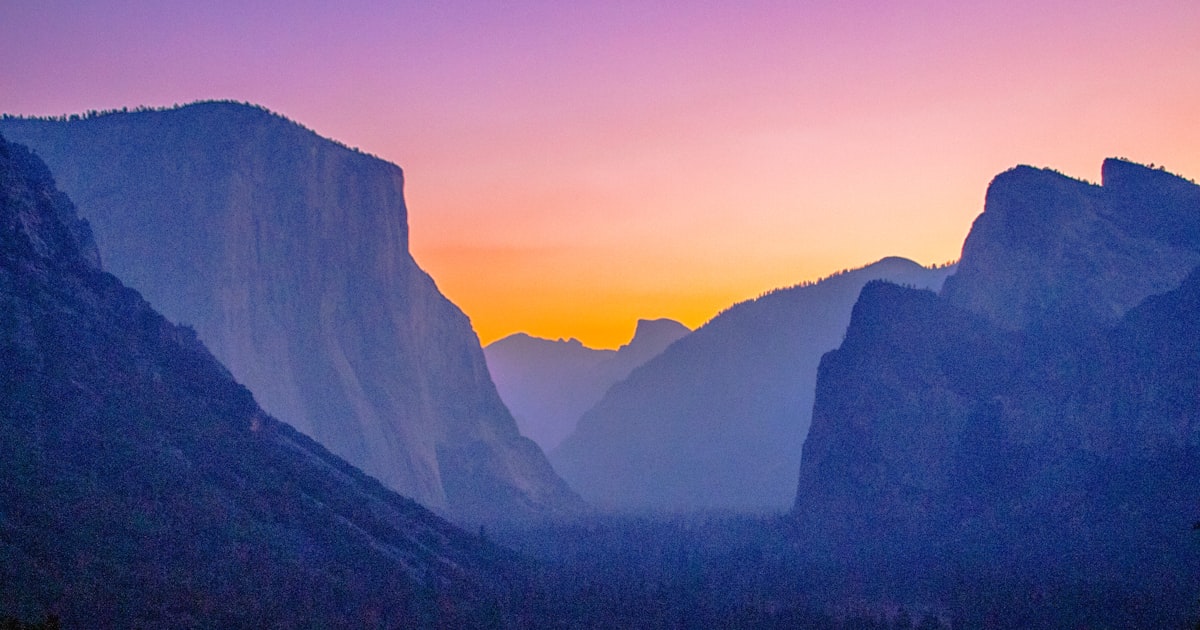
Yosemite is one of those places you feel like you already know before you arrive — you've seen Ansel Adams' photographs, the iconic Valley View framing El Capitan in the foreground, the famous silhouette of Half Dome at sunset. What surprised me, going in June, was how much more dynamic and chaotic it feels than the photographs suggest. The waterfalls were still going strong from snowmelt, filling the valley with a constant, distant roaring; the Merced River was running high and fast and cold; and the light at the granite walls was doing something I've never quite seen reproduced on a screen — the way warm afternoon sun catches the pale face of El Capitan and turns it almost golden while the opposite walls stay in blue shadow.
Yosemite Valley is the heart of it — a seven-mile long, one-mile wide glacially carved valley surrounded by sheer granite walls rising thousands of feet overhead, occupied by meadows and the Merced River and the main visitor services. It's genuinely crowded in summer, which the timed entry permit system is designed to manage; I'd encourage getting that sorted before you go. But for all its visitor volume, the valley is big enough that once you're on a trail or away from the main pullouts, it thins out considerably.
El Capitan is the 3,000-foot vertical granite wall that rock climbers come to Yosemite to test themselves against — it's visible from throughout the valley and worth stopping to stare at for a while, especially if you can spot the tiny bright specks of climbers bivouacked on the wall. Half Dome, the iconic rounded-off granite monolith at the valley's eastern end, is the park's most recognizable feature. Yosemite Falls, at 2,425 feet the tallest waterfall in North America, was roaring in late June — audible from the valley floor a good distance away, and misting everything within range.
Glacier Point, accessible by road (or a long hike), gives you the classic high-angle view looking down into the valley from 3,200 feet above — the viewpoint that captures that famous perspective. It's a must.